Methylene blue (methylthioninium chloride) has attracted renewed interest as a research compound with proposed benefits for mitochondrial support and cognitive function. As demand has grown beyond its established clinical uses, so has the availability of methylene blue products at varying grades and price points — from pharmaceutical-grade preparations to industrial dyes sold online. The grade you choose is not a matter of preference; it is a fundamental safety issue.
This article explains what separates United States Pharmacopeia (USP) grade methylene blue from laboratory, reagent, or industrial-grade alternatives, what contaminants lower grades may carry, and why anyone considering methylene blue for health-related purposes should accept nothing less than pharmaceutical purity. This is informational content, not medical advice. Methylene blue is a potent drug with serious interaction risks and contraindications, and its use should be discussed with a qualified healthcare provider.
Key Takeaways
- USP grade means tested to pharmacopeial standards for human use; lab, reagent, and industrial grades do not meet this bar, regardless of percentage purity claims.
- Non-pharmaceutical methylene blue may contain azure dyes, heavy metals, and residual solvents at concentrations that are unacceptable for human ingestion.
- Methylene blue is a potent MAOI with a narrow therapeutic index and serious FDA-warned serotonin syndrome risk when combined with serotonergic medications.[1]
- G6PD deficiency is an absolute contraindication to methylene blue use; hemolytic anemia can be severe and life-threatening.
- Legitimate pharmaceutical-grade sources provide lot-specific Certificates of Analysis from accredited labs covering impurities, not just dye content percentage.
What Grade Labeling Actually Means
Chemical grading systems exist to communicate the intended use and verified purity of a substance. United States Pharmacopeia (USP) grade means the compound meets the identity, strength, quality, and purity standards published in the USP — a legally recognized compendium in the United States. For methylene blue, this means tested freedom from specific toxic impurities, verified dye content within a narrow acceptable range, and manufacturing under conditions consistent with pharmaceutical practice.
Laboratory or reagent grade (sometimes called ACS grade) indicates suitability for analytical and research work in laboratory settings. These standards ensure the compound is pure enough not to interfere with chemical assays, but they do not establish safety for human consumption. Industrial or histology-grade methylene blue — widely used as a biological stain for microscopy, textile dyeing, and wastewater treatment — carries no purity guarantees relevant to human ingestion at all. The starting materials, synthesis conditions, and permissible impurity profiles differ substantially across these categories.
A compound can be labeled ‘99% pure’ in a non-pharmaceutical context and still contain trace heavy metals, synthesis byproducts, or residual solvents at levels that are unacceptable for human use. Percentage purity in a certificate of analysis refers to the primary compound only; it says nothing about what the remaining fraction contains.
Known Impurities in Non-Pharmaceutical Grades
Industrial and lower-grade methylene blue preparations are synthesized using processes optimized for yield and cost, not human safety. Common contaminants identified in non-pharmaceutical dye products include azure dyes (azure A, azure B, thionine), which are related phenothiazine compounds with their own pharmacological activity. The presence of these impurities at uncertain concentrations makes dose estimation unreliable and introduces unknown biological effects.
Heavy metal contamination is a documented concern in industrial dye manufacturing. Arsenic, lead, and mercury can be present as trace process impurities. Even at microgram-level exposures, chronic heavy metal accumulation poses toxicological risk. Residual organic solvents from synthesis or extraction — compounds not intended for human consumption — may also be present in non-USP material at levels that would fail pharmaceutical limits.

Histology-grade methylene blue sold for microscopy staining is often not required to provide certificates of analysis documenting impurity profiles, and vendors of such material explicitly label it ‘not for human use.’ Purchasing this grade for personal consumption on the basis of price is a decision made without information about what else is being ingested.
Why Methylene Blue's Pharmacology Makes Purity Especially Critical
Methylene blue is pharmacologically active at very low doses. Proposed mechanisms of interest — including acting as an electron carrier in the mitochondrial respiratory chain, supporting cytochrome c oxidase activity, and scavenging reactive oxygen species — operate in the low microgram-per-kilogram range.[3] This is not an inert substance where a modest impurity burden is inconsequential; it is a drug with dose-dependent effects that extend into toxicity at higher exposures.
Most significantly, methylene blue is a potent monoamine oxidase inhibitor (MAOI). The FDA has issued a drug safety communication warning of potentially fatal serotonin syndrome when methylene blue is co-administered with serotonergic drugs including SSRIs, SNRIs, tramadol, and linezolid. This warning applies to pharmaceutical-grade methylene blue at clinical doses. If impurities in a non-USP product alter its effective pharmacological concentration — in either direction — the risk calculus for interactions becomes impossible to manage.
The dose-response curve for methylene blue is also paradoxical. At low doses, it reduces methemoglobin and functions as an antioxidant electron shuttle. At doses above approximately 4 mg/kg, it can paradoxically induce the very methemoglobinemia it is FDA-approved to treat at lower doses.[2] This narrow therapeutic index makes precise, reliable dosing essential — which in turn depends on a product of known, consistent purity.
G6PD Deficiency: An Absolute Contraindication
Glucose-6-phosphate dehydrogenase (G6PD) deficiency is an X-linked inherited condition estimated to affect over 400 million people globally. In individuals with G6PD deficiency, methylene blue cannot be reduced back to its colorless form (leucomethylene blue) by red blood cells, making it ineffective as a methemoglobin treatment and simultaneously triggering severe hemolytic anemia — rupture of red blood cells.
This contraindication is absolute. It applies to pharmaceutical-grade methylene blue and would apply with equal or greater severity to impure preparations where actual drug content is unknown. Individuals who do not know their G6PD status should be tested before any consideration of methylene blue use. G6PD deficiency prevalence is higher in populations with ancestry from sub-Saharan Africa, the Mediterranean, the Middle East, and Southeast Asia, and many affected individuals are asymptomatic until exposed to an oxidant trigger.
How to Identify Legitimate Pharmaceutical-Grade Methylene Blue
Pharmaceutical-grade methylene blue for human use in the United States is available as an FDA-approved injectable (Provayblue, 5 mg/mL) and through compounding pharmacies that operate under state pharmacy board oversight and, for sterile preparations, additional FDA oversight. Oral preparations are available through licensed compounding pharmacies and are formulated to USP specifications. These sources provide a chain of documentation that lower-grade suppliers cannot replicate.
When evaluating any methylene blue product, look for: a Certificate of Analysis (CoA) from an accredited third-party laboratory, explicit USP grade designation with a lot-specific purity result, testing for heavy metals and residual solvents per USP guidelines, and a manufacturer or supplier operating under cGMP (current Good Manufacturing Practice) conditions. A product that cannot provide a third-party CoA, or whose CoA only reports percent dye content without impurity testing, does not meet the standard appropriate for human use.
The characteristic deep blue color of methylene blue solutions is not itself a purity indicator. Azure impurities are also colored; a visually appealing solution can still contain pharmacologically active contaminants. Color, odor, and appearance cannot substitute for analytical documentation.
Practical Guidance on Grade Selection
For anyone working with methylene blue in a laboratory context — cell culture, staining, biochemical assays — reagent or ACS grade is typically appropriate for the intended application. These grades exist for good reason and are well-suited to non-human use cases.
For any application involving human ingestion or administration, USP grade from a documented pharmaceutical source is the only appropriate choice. This is not a conservative recommendation — it is the minimum standard consistent with knowing what you are actually consuming. Industrial and histology-grade material is explicitly not for human use, and that labeling reflects a real difference in manufacturing standards, not merely regulatory formality.
Cost is a poor guide here. USP-grade methylene blue costs more than industrial dye. If a product is priced similarly to histology stain, that is a signal worth heeding. The compounds may share a name and a color, but they are not equivalent products for human health applications.
🛒 Where to Buy Methylene Blue
- Troscriptions Blue CannatineLab-tested / studied
sublingual troches, 4 mg methylene blue + 4 mg nicotine + 50 mg caffeine + 200 mg alpha-GPC per troche — Flagship stacked nootropic troche from Troscriptions (founded by physician Ted Achacoso MD); pharmaceutical-grade MB combined with cholinergic and stimulant cofactors; widely regarded as the benchmark MB product in the nootropic community. Confirm drug interaction checklist before use. - Double Wood Supplements Methylene Blue
capsules, 5 mg per capsule — Accessible entry-point brand widely available on Amazon; transparent third-party testing; one of the few capsule-form MB products from an established U.S. supplement company; good for low-dose protocols. - Health Natura Methylene Blue USP Solution
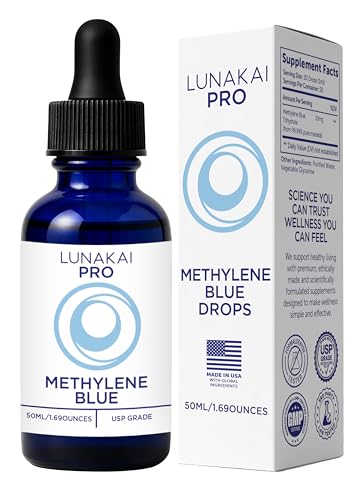
liquid, 0.5% solution, approximately 2.5 mg per 5 drops — Long-standing liquid MB brand; clear USP-grade labeling; 0.5% concentration referenced in historical clinical protocols; glass dropper bottle; available on Amazon. - BulkSupplements Methylene Blue Powder
powder, Variable — sold as raw tested powder; requires accurate milligram scale — Lowest cost-per-dose option for experienced users; lab-tested with published COA; not recommended for anyone new to the compound given the critical importance of accurate low-dose measurement.
As an Amazon Associate we earn from qualifying purchases. Methylene blue grade matters more than price or color: only USP, BP, or EP pharmaceutical grade is appropriate for human use, and aquarium, histology or industrial dye grades are not substitutes. Ask for a lot-specific third-party certificate of analysis with numerical results covering azure B and heavy metals, since a bare percent-purity figure says nothing about the remaining fraction.


A Note on the Evidence
This page is a sourcing and product-grade guide rather than a review of clinical research: the grade definitions, impurity limits and certificate-of-analysis expectations described above come from pharmacopeial standards and manufacturer documentation, not from clinical trial results. Methylene blue is a pharmaceutical drug, not a supplement — its use carries real risks including fatal drug interactions and absolute contraindications, and it should only be considered under the supervision of a qualified healthcare provider familiar with its full risk profile.
Frequently Asked Questions
Can I use aquarium or fish tank methylene blue for health purposes?
No. Aquarium methylene blue is formulated for aquatic pathogen control, not human consumption, and carries no purity guarantees relevant to human use. The impurity profile of aquarium-grade material is unknown and potentially hazardous. Only pharmaceutical-grade (USP) material from documented sources is appropriate for any health-related consideration.
What is the serotonin syndrome risk with methylene blue?
The FDA has issued a drug safety communication warning that methylene blue, as a potent monoamine oxidase inhibitor, can cause potentially fatal serotonin syndrome when given with serotonergic drugs including SSRIs, SNRIs, tramadol, and linezolid. This risk is serious and well-documented in clinical settings. Anyone taking any serotonergic medication should not use methylene blue without direct physician oversight.
Is a 99% purity claim on a certificate of analysis sufficient assurance for human use?
Not on its own. A purity percentage refers to the primary compound content; it does not describe what the remaining fraction contains. A CoA suitable for evaluating human-use suitability must also include testing for heavy metals (arsenic, lead, mercury), residual solvents, and related substance impurities such as azure dyes, performed by an accredited third-party laboratory against pharmacopeial limits.
Why does methylene blue paradoxically cause methemoglobinemia at high doses when it treats it at low doses?
At therapeutic doses (typically 1–2 mg/kg), methylene blue is reduced to leucomethylene blue by NADPH-dependent reductase in red blood cells and then acts as an electron carrier to convert methemoglobin back to functional hemoglobin. At doses above approximately 4 mg/kg, this reductive pathway becomes saturated and methylene blue itself acts as an oxidant, converting hemoglobin to methemoglobin. This paradoxical toxicity underscores why precise, reliable dosing from a purity-verified product is essential.
Who should absolutely avoid methylene blue regardless of grade?
Individuals with confirmed or suspected G6PD deficiency should not use methylene blue — it can cause severe hemolytic anemia in this population. Anyone taking SSRIs, SNRIs, tramadol, linezolid, or other serotonergic drugs faces serious serotonin syndrome risk and should not combine these with methylene blue except under direct physician supervision. Pregnant or breastfeeding individuals, and those with known hypersensitivity to phenothiazines, should also avoid it.
Where can I obtain pharmaceutical-grade methylene blue legally?
In the United States, pharmaceutical-grade methylene blue is available as the FDA-approved injectable Provayblue through hospital pharmacies, and in oral or lower-dose forms through licensed compounding pharmacies operating under state board and applicable FDA oversight. A prescription is required. Purchasing through these regulated channels is the only way to access material with documented pharmaceutical-grade purity and a legitimate supply chain.
References
- Methylene blue: a controversial diagnostic acid and medication? Toxicology Research (2022). PMID 36337249
- The Potentials of Methylene Blue as an Anti-Aging Drug. Cells (2021). PMID 34943887
- From Mitochondrial Function to Neuroprotection – an Emerging Role for Methylene Blue. Molecular Neurobiology (2018). PMID 28840449
These statements have not been evaluated by the Food and Drug Administration. This information is not intended to diagnose, treat, cure, or prevent any disease. Content is for informational purposes only and is not medical advice; consult a qualified healthcare provider before starting any supplement. As an Amazon Associate we earn from qualifying purchases.