Interest in compounds that support mitochondrial energy production has grown substantially, and two names that come up repeatedly are coenzyme Q10 (CoQ10, also sold as its reduced form ubiquinol) and methylene blue. Both are proposed to influence the electron transport chain — the cellular machinery that converts nutrients into ATP — but they do so through distinct mechanisms, carry different safety profiles, and are backed by very different bodies of evidence.[3]
This article lays out what is currently understood about each compound, where the research is strong, where it is preliminary, and what practical considerations matter most for someone evaluating whether either belongs in their routine. Neither should be viewed as a cure or guaranteed performance enhancer, and this article is informational, not medical advice.
Key Takeaways
- CoQ10 and ubiquinol have a decades-long safety record and the strongest clinical evidence among mitochondrial supplements, particularly for statin users, heart failure patients, and those over 40.
- Methylene blue has a compelling mechanistic profile as an electron carrier and MAO inhibitor, but human evidence for cognitive or longevity applications remains early and limited.
- Methylene blue carries serious risks — serotonin syndrome with any serotonergic drug and severe hemolytic anemia in G6PD deficiency — that make it categorically less safe for unsupervised use than CoQ10.[1]
- Only USP-grade methylene blue is appropriate for human use; purity is non-negotiable and distinguishes pharmaceutical product from toxic industrial material.
- For most people without specific medical conditions, CoQ10 is the more evidence-supported and substantially safer starting point; methylene blue is experimental territory best approached with physician guidance.
How CoQ10 and Ubiquinol Work in the Mitochondria
CoQ10 (ubiquinone) is a fat-soluble molecule synthesized naturally in the body that functions as an electron carrier within the inner mitochondrial membrane. It shuttles electrons between Complex I and Complex II to Complex III in the electron transport chain, a step essential for generating the proton gradient that drives ATP synthesis. Without adequate CoQ10, this chain slows, and cellular energy output drops.
Ubiquinol is the fully reduced, active antioxidant form of CoQ10. The body interconverts the two forms, but as people age or in the presence of oxidative stress, conversion efficiency may decrease. Ubiquinol is therefore marketed as a more bioavailable option, particularly for older adults or those on statins — drugs known to deplete endogenous CoQ10 by blocking the mevalonate pathway that produces it. CoQ10 levels in tissues naturally decline with age, which has driven research into supplementation for cardiovascular function, exercise performance, and conditions involving mitochondrial insufficiency.
The overall evidence base for CoQ10 is one of the more robust among commonly sold mitochondrial supplements. Clinical trials have examined its use in heart failure, statin-associated myopathy, and fertility. Results are mixed but include enough positive signals in specific populations that several professional medical bodies acknowledge its potential utility in defined contexts.
How Methylene Blue Interacts with the Electron Transport Chain
Methylene blue (methylthioninium chloride) is a century-old synthetic dye with an unusual property: it can accept electrons directly from NADH and transfer them to cytochrome c, effectively acting as an alternative electron carrier that bypasses Complexes I, II, and III. This means it can, in theory, maintain electron flow even when parts of the chain are dysfunctional or inhibited. At low doses, it also appears to upregulate cytochrome c oxidase (Complex IV), the terminal enzyme that transfers electrons to oxygen.
Additionally, methylene blue is a potent monoamine oxidase inhibitor (MAOI) and at low doses may exert antioxidant effects by intercepting reactive oxygen species before they cause oxidative damage. Research has explored potential applications in cognitive function, neurodegenerative conditions including Alzheimer’s disease (via tau aggregation inhibition), and as a neuroprotective agent in hypoxic or ischemic conditions. However, the human clinical evidence for these proposed nootropic or longevity applications remains preliminary; much of the mechanistic work has been conducted in cell cultures and animal models.

Crucially, methylene blue is an FDA-approved pharmaceutical — approved at intravenous doses for acquired methemoglobinemia — not a dietary supplement.[2] This distinction carries significant regulatory and safety implications that CoQ10, a supplement with a long safety record, does not share.
Evidence Quality: A Candid Assessment
CoQ10 has been studied in hundreds of clinical trials across multiple decades. Evidence is strongest for heart failure (where some meta-analyses suggest improvements in ejection fraction and symptom scores), statin-induced myopathy, and male fertility parameters. Evidence for cognitive benefit, exercise performance in healthy individuals, and general anti-aging effects is weaker and inconsistent. Importantly, CoQ10 has a well-characterized safety profile developed over decades of widespread human use.
Methylene blue’s human clinical evidence base for cognitive or performance enhancement is far thinner. Most mechanistic data come from in vitro studies or rodent experiments. A small number of human trials have examined memory and attention outcomes with low-dose methylene blue, with some showing modest positive results, but these studies are few, small, and not yet replicated at scale. The gap between compelling mechanistic hypotheses and demonstrated human benefit is substantial, and anyone evaluating methylene blue should be clear-eyed that it is an investigational application, not an established one.
This comparison is written at the level of mechanism, regulatory status and practical use rather than as a synthesis of trial results, so it does not weigh individual studies against one another. Anyone researching either compound should search PubMed directly for systematic reviews and randomized controlled trials, prioritizing those in human subjects over animal or cell-line research.
Safety Profiles: Where They Diverge Sharply
CoQ10 has an excellent safety record at commonly used doses (100–300 mg/day for most applications). Side effects are uncommon and typically mild — occasional gastrointestinal discomfort at high doses. It has no significant drug interaction warnings for most people, though it may modestly potentiate anticoagulants in some individuals, and people on warfarin should inform their prescribers. It is not recommended during pregnancy due to limited data. Overall, it is one of the better-tolerated supplements in widespread use.
Methylene blue carries a categorically different risk profile. As a potent MAOI, it carries a serious FDA black-box-equivalent drug interaction warning: co-administration with serotonergic drugs — SSRIs, SNRIs, tricyclics, tramadol, linezolid, or other MAOIs — can trigger serotonin syndrome, a potentially life-threatening condition. This warning applies even to low oral doses sometimes marketed as ‘nootropic’ amounts. It is absolutely contraindicated in G6PD deficiency, a common inherited enzyme deficiency where methylene blue triggers severe hemolytic anemia instead of treating methemoglobinemia. There is also a paradoxical dose-response: at low doses it treats methemoglobinemia, but at doses above approximately 4 mg/kg it can cause the very same condition. Product purity is critical — only USP-grade (pharmaceutical-purity) methylene blue is appropriate for any human use; industrial or histology-grade material contains impurities that make it toxic.
The safety contrast between these two compounds is the single most important practical difference for most individuals. CoQ10 is broadly safe for self-supplementation with minimal precautions. Methylene blue requires significant caution, medical screening for G6PD deficiency and drug interactions, and ideally physician oversight — especially for anyone on any serotonergic medication whatsoever.
Who Might Consider Each Compound
CoQ10 or ubiquinol has the clearest rationale for people over 40 (when endogenous production naturally declines), individuals currently prescribed statin medications, those with diagnosed heart failure being managed by a cardiologist, men being evaluated for infertility, and people with conditions associated with mitochondrial dysfunction where a physician has suggested its use. Ubiquinol may be preferred for older adults or those with absorption concerns, though cost is higher. For healthy younger adults seeking general energy optimization, the evidence is less compelling.
Methylene blue at low doses is under investigation as a cognitive support compound and has a theoretically interesting mechanism, but the evidence for benefit in healthy humans is not yet sufficient to recommend it casually. People most likely to encounter it are those deeply engaged with experimental longevity protocols, biohackers aware of and willing to manage its risks, or patients under physician care for specific conditions. It is not appropriate for anyone on SSRIs, SNRIs, or other serotonergic medications, anyone with known or suspected G6PD deficiency, or anyone unwilling to source verified USP-grade material.
The two compounds are not directly substitutable — they target overlapping but distinct points in mitochondrial physiology. Some protocols combine them under medical supervision, but this is experimental territory, and layering them increases complexity without a clear additive benefit established in human trials.
Practical Considerations: Form, Dose, and What to Look For
For CoQ10, softgel formulations with fat-soluble carriers improve absorption substantially over dry capsules. Taking it with a meal containing fat is recommended. Ubiquinol may absorb more readily, particularly in older adults. Doses in most clinical trials for defined conditions have ranged from 100 mg to 600 mg daily depending on the application, with 100–200 mg being typical for general use. Look for products from reputable manufacturers with third-party testing (USP, NSF, or ConsumerLab verification). Brand reliability matters more than any particular marketing claim.
For methylene blue, if a person has received medical clearance and wishes to explore its use, the source matters enormously. Only pharmaceutical-grade (USP-grade) product is appropriate; industrial or laboratory histology-grade material is not safe for human consumption regardless of price or availability. Doses discussed in nootropic contexts are typically in the range of 0.5–4 mg/kg body weight, but even these low doses carry the full MAOI and G6PD contraindication risk. It should not be combined with any serotonergic medication. A physician’s involvement is strongly advisable. Oral solutions (liquid form) are the most common delivery method outside of intravenous pharmaceutical use.
🛒 Where to Buy Methylene Blue
- Troscriptions Blue CannatineLab-tested / studied
sublingual troches, 4 mg methylene blue + 4 mg nicotine + 50 mg caffeine + 200 mg alpha-GPC per troche — Flagship stacked nootropic troche from Troscriptions (founded by physician Ted Achacoso MD); pharmaceutical-grade MB combined with cholinergic and stimulant cofactors; widely regarded as the benchmark MB product in the nootropic community. Confirm drug interaction checklist before use. - Double Wood Supplements Methylene Blue
capsules, 5 mg per capsule — Accessible entry-point brand widely available on Amazon; transparent third-party testing; one of the few capsule-form MB products from an established U.S. supplement company; good for low-dose protocols. - Health Natura Methylene Blue USP Solution
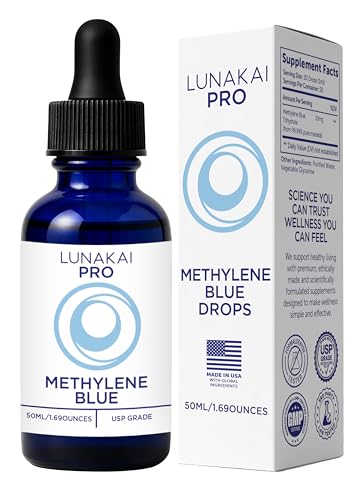
liquid, 0.5% solution, approximately 2.5 mg per 5 drops — Long-standing liquid MB brand; clear USP-grade labeling; 0.5% concentration referenced in historical clinical protocols; glass dropper bottle; available on Amazon. - BulkSupplements Methylene Blue Powder
powder, Variable — sold as raw tested powder; requires accurate milligram scale — Lowest cost-per-dose option for experienced users; lab-tested with published COA; not recommended for anyone new to the compound given the critical importance of accurate low-dose measurement.
As an Amazon Associate we earn from qualifying purchases. Methylene blue grade matters more than price or color: only USP, BP, or EP pharmaceutical grade is appropriate for human use, and aquarium, histology or industrial dye grades are not substitutes. Ask for a lot-specific third-party certificate of analysis with numerical results covering azure B and heavy metals, since a bare percent-purity figure says nothing about the remaining fraction.


A Note on the Evidence
Neither compound should be started without discussing current medications with a prescriber; methylene blue in particular carries serious drug interaction risks with serotonergic medications and is contraindicated in G6PD deficiency. Much of the evidence for both compounds — especially methylene blue’s nootropic and longevity applications — comes from early-stage or animal research, and effects in healthy humans at commonly used doses are not reliably established. This article is informational only and does not constitute medical advice.
Frequently Asked Questions
Can I take methylene blue and CoQ10 together?
There is no known direct pharmacological interaction between methylene blue and CoQ10. However, layering them does not have established evidence of additive benefit in humans, and methylene blue’s MAOI activity and other risks remain present regardless of what else is co-administered. Any combination protocol involving methylene blue should be supervised by a physician familiar with its interactions.
Is ubiquinol always better than CoQ10 (ubiquinone)?
Ubiquinol is the reduced, active antioxidant form and may absorb more efficiently in some populations, particularly older adults. However, the body interconverts both forms, and well-formulated ubiquinone softgels with absorption enhancers perform adequately for many people. The practical difference for younger, healthy individuals is modest. Cost is substantially higher for ubiquinol, so the choice depends on age, health status, and budget.
What is G6PD deficiency and why does it matter for methylene blue?
Glucose-6-phosphate dehydrogenase (G6PD) deficiency is a common inherited enzyme deficiency, particularly prevalent in people of African, Mediterranean, and Southeast Asian descent. Methylene blue requires functional G6PD activity to produce its antioxidant and methemoglobin-reducing effects; in G6PD-deficient individuals, it instead causes severe hemolytic anemia. Anyone considering methylene blue should be tested for G6PD deficiency beforehand, as this is an absolute contraindication.
Do statins really deplete CoQ10?
Statins inhibit HMG-CoA reductase, blocking the mevalonate pathway that produces both cholesterol and CoQ10. This mechanism is well-established, and measurable reductions in plasma CoQ10 levels have been documented in people taking statins. Whether supplementation reliably reverses statin-associated muscle symptoms is debated — clinical trial results are mixed — but the biological rationale for CoQ10 depletion by statins is solid.
What does 'methylene blue is an MAOI' mean practically?
Monoamine oxidase inhibitors block the enzyme that breaks down neurotransmitters including serotonin, dopamine, and norepinephrine. When an MAOI like methylene blue is combined with drugs that increase serotonin levels — SSRIs (fluoxetine, sertraline, etc.), SNRIs (venlafaxine, duloxetine), tramadol, or linezolid — serotonin can accumulate to dangerous levels, causing serotonin syndrome: agitation, rapid heart rate, high blood pressure, hyperthermia, and in severe cases, seizures or death. This is not a minor caution; it is a serious drug interaction that applies even at low oral methylene blue doses.
Is there any context where methylene blue is the clearly better choice over CoQ10?
For most healthy individuals seeking mitochondrial support, CoQ10 has a far stronger evidence base and safety record. Methylene blue’s theoretical advantages — electron chain bypass, Complex IV upregulation, tau inhibition — are scientifically interesting but not yet demonstrated robustly in human trials for these applications. In the clinical setting, intravenous methylene blue is the standard of care for acquired methemoglobinemia, where it has no meaningful competition. Outside of that approved indication, it remains investigational.
References
- Methylene blue: a controversial diagnostic acid and medication? Toxicology Research (2022). PMID 36337249
- The Potentials of Methylene Blue as an Anti-Aging Drug. Cells (2021). PMID 34943887
- From Mitochondrial Function to Neuroprotection – an Emerging Role for Methylene Blue. Molecular Neurobiology (2018). PMID 28840449
These statements have not been evaluated by the Food and Drug Administration. This information is not intended to diagnose, treat, cure, or prevent any disease. Content is for informational purposes only and is not medical advice; consult a qualified healthcare provider before starting any supplement. As an Amazon Associate we earn from qualifying purchases.