Methylene blue is not a single product — it is a category that spans pharmaceutical-grade reagents, industrial textile dyes, aquarium treatments, and histology stains, all sharing the same vivid blue color but differing sharply in purity and safety. For anyone researching its nootropic or mitochondrial applications, this distinction is not a minor detail; impurities present in non-pharmaceutical grades can include heavy metals, unreacted precursor chemicals, and toxic synthesis byproducts that have no place inside a human body.
A Certificate of Analysis, or COA, is the primary document a responsible supplier uses to demonstrate what is actually in a batch of methylene blue. Reading one correctly takes about five minutes once you know what to look for, and it is the single most reliable step you can take before purchasing. This guide explains the key fields on a COA, the purity standards that matter, common impurity profiles, and the warning signs that should prompt you to walk away from a product.
Key Takeaways
- Only USP, BP, or EP pharmaceutical-grade methylene blue carries documented assay and impurity testing appropriate for internal human use — industrial, histology, and aquarium grades do not.
- A valid COA should be lot-specific, show numerical results (not just pass/fail), identify the test methods used (HPLC for organics), and list heavy metals individually including arsenic, lead, and mercury.
- Third-party testing by an ISO/IEC 17025-accredited laboratory provides stronger assurance than an in-house manufacturer COA alone.
- Azure B and related demethylated analogs are the characteristic organic impurities in methylene blue; a COA should quantify them, not merely note their absence.
- Aquarium-grade and histology-grade methylene blue are not substitutes for pharmaceutical grade regardless of the stated concentration on the label.
Why Grade Matters More Than Color
All methylene blue shares the same chemical structure — 3,7-bis(dimethylamino)phenothiazin-5-ium chloride — and, at any purity level, it is intensely blue. This creates a misleading impression that any blue powder or solution is equivalent. In practice, the synthesis of methylene blue generates a predictable set of related compounds: Azure A, Azure B, Azure C, and thionine, each of which is a demethylated analog of the parent molecule. Industrial and histology grades tolerate these co-pigments at relatively high levels because they do not affect staining quality. For internal human use, they represent unknown pharmacological variables whose safety profiles have not been characterized.
Beyond co-pigments, industrial methylene blue production can introduce heavy metal residues — particularly arsenic, lead, and mercury — from reagents and equipment that meet manufacturing tolerances for dye applications but not for pharmaceutical use. The United States Pharmacopeia (USP) monograph for methylene blue sets strict upper limits on each of these contaminants precisely because the pharmaceutical-grade designation exists to protect patients. When a supplier cannot provide documentation showing conformance to a recognized pharmacopeial standard, the grade is, by definition, unknown.
Understanding USP, BP, and EP Grade Designations
Three major pharmacopeial standards govern pharmaceutical-grade methylene blue: the United States Pharmacopeia (USP), the British Pharmacopoeia (BP), and the European Pharmacopoeia (EP). Each publishes a formal monograph specifying minimum assay percentage, acceptable impurity limits, physical tests, and the analytical methods used to confirm compliance. A product described as ‘USP grade’ or ‘BP grade’ should carry documentation — typically a COA from the manufacturer and ideally a confirming report from an independent laboratory — demonstrating it was actually tested against those methods.
The words ‘pharmaceutical grade’ and ‘USP grade’ can appear on marketing copy without verification. The operative word is ‘tested.’ A COA is the test record, and it should name the specific pharmacopeial standard, list the test methods by catalog number or section reference, show the actual numerical results for each test, and show the specification limit each result was compared against. A COA that lists only pass/fail outcomes without numerical data, or that does not name a reference standard, provides much weaker assurance.
Research-grade methylene blue from laboratory chemical suppliers (such as Sigma-Aldrich reagent grade) is sometimes conflated with pharmaceutical grade. Research-grade material may have high assay purity for a single compound but is manufactured under conditions designed for laboratory use, not internal human consumption, and may not be tested for the full suite of safety-relevant impurities that a pharmacopeial monograph requires.

Key Fields on a Methylene Blue COA
When you receive or download a COA, the first thing to confirm is the lot number and whether it matches the lot number on the product you are evaluating. A COA for a different batch tells you nothing about what is in your bottle. Reputable suppliers print or stamp the lot number on the product label and can provide a lot-specific COA on request.
Assay is the core purity test and should be expressed as a percentage of the anhydrous basis or the declared active content. The USP monograph for methylene blue specifies a minimum assay of 98.0% and a maximum of 103.0% when calculated on a dried basis. A result below 98% indicates the material does not meet USP specification. A result above 103% often indicates a moisture or calibration issue and warrants scrutiny.
The COA should also list results for: loss on drying or water content (methylene blue is hygroscopic and absorbs atmospheric moisture, which affects actual dose per weight); residue on ignition (inorganic ash content); heavy metals (arsenic, lead, mercury, cadmium individually, not just a combined total); and related substances or organic impurities, which is where Azure A, Azure B, and other co-pigments appear. Each of these should show a numerical result alongside the specification limit. If an impurity field shows only ‘conforms’ or ‘passes’ without a number, ask the supplier for the underlying data.
Azure Dyes and Organic Impurities: What to Look For
The most chemically meaningful impurity category for methylene blue is the related substances panel, which captures demethylated analogs formed during synthesis. Azure B (the primary demethylation product) and Azure A are the most common. At trace levels, these compounds are likely pharmacologically insignificant. At higher concentrations, they introduce uncertainty because they interact with some of the same enzyme systems as methylene blue — particularly monoamine oxidase — but their potency and selectivity relative to the parent compound are not well characterized in human studies.[1]
A USP-compliant related substances result should show Azure B below the specified limit, with total impurities not exceeding the monograph threshold. High-performance liquid chromatography (HPLC) is the standard analytical method for this panel, and the COA should identify it as such. Thin-layer chromatography (TLC) can detect major impurities but lacks the sensitivity and quantitative precision of HPLC for trace-level related substance work. If a COA for a supplement product references only TLC for organic impurities, it provides less confidence than an HPLC-based result.
Third-Party Testing and Supply Chain Transparency
A COA produced by the same manufacturer that made the product is called an in-house or first-party certificate. It represents the manufacturer’s own testing and carries the manufacturer’s accountability for accuracy. A COA from an independent, accredited laboratory is called a third-party certificate and provides an additional layer of verification because the testing entity has no financial interest in a favorable result.
For methylene blue sold into the human supplement or nootropic market, third-party testing by a laboratory accredited under ISO/IEC 17025 is the strongest form of documentation available. ISO/IEC 17025 accreditation means the laboratory’s methods have been externally audited for competence and that its calibration chain is traceable to national standards. When evaluating a supplier, ask whether the COA is from an ISO/IEC 17025-accredited laboratory, and confirm the laboratory’s name and accreditation number, which you can cross-reference against your national accreditation body’s public database.
Supply chain transparency also means knowing the origin of the active pharmaceutical ingredient (API). Methylene blue API is manufactured at a small number of pharmaceutical facilities globally. A supplement supplier who can identify the API manufacturer and provide that manufacturer’s batch records, in addition to their own finished-product COA, demonstrates a meaningfully higher level of oversight than a supplier who only provides a single in-house document.
Practical Red Flags When Evaluating a Product or Supplier
Several patterns should prompt caution regardless of the marketing language used. First, no COA at all, or a COA available only upon request that arrives weeks later or looks generic rather than lot-specific, is a significant concern. Legitimate pharmaceutical suppliers maintain lot-specific COAs as a standard documentation requirement. Second, a COA that does not list heavy metals individually — or that groups all heavy metals into a single ‘heavy metals NMT 10 ppm’ line without specifying arsenic, lead, mercury, and cadmium separately — does not meet the detail level expected of pharmacopeial testing. Third, a price dramatically below the market rate for pharmaceutical-grade methylene blue is a useful signal: USP-grade material costs more to produce and test than industrial or aquarium grade, and prices that cannot support pharmaceutical manufacturing economics often indicate the grade is not what the label claims.
Aquarium and pond treatments sold under names like ‘Kordon Methylene Blue’ are explicitly formulated and labeled for fish disease treatment. They typically contain methylene blue at a known concentration but are not manufactured under pharmaceutical current Good Manufacturing Practice (cGMP) conditions, are not tested against human-use pharmacopeial specifications, and may include preservatives or other additives that are not intended for internal human use. Using aquarium-grade products because they are inexpensive is not a reasonable cost-saving measure when pharmacopeial-grade alternatives are accessible.
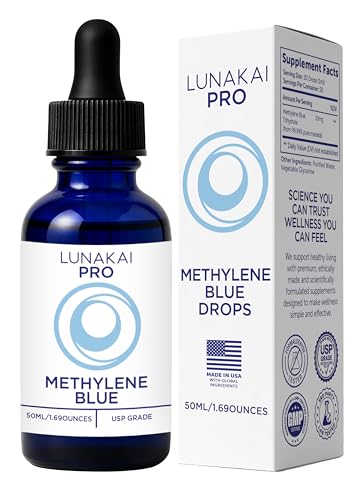
🛒 Where to Buy Methylene Blue
- Troscriptions Blue CannatineLab-tested / studied
sublingual troches, 4 mg methylene blue + 4 mg nicotine + 50 mg caffeine + 200 mg alpha-GPC per troche — Flagship stacked nootropic troche from Troscriptions (founded by physician Ted Achacoso MD); pharmaceutical-grade MB combined with cholinergic and stimulant cofactors; widely regarded as the benchmark MB product in the nootropic community. Confirm drug interaction checklist before use. - Double Wood Supplements Methylene Blue
capsules, 5 mg per capsule — Accessible entry-point brand widely available on Amazon; transparent third-party testing; one of the few capsule-form MB products from an established U.S. supplement company; good for low-dose protocols. - Health Natura Methylene Blue USP Solution
liquid, 0.5% solution, approximately 2.5 mg per 5 drops — Long-standing liquid MB brand; clear USP-grade labeling; 0.5% concentration referenced in historical clinical protocols; glass dropper bottle; available on Amazon. - BulkSupplements Methylene Blue Powder
powder, Variable — sold as raw tested powder; requires accurate milligram scale — Lowest cost-per-dose option for experienced users; lab-tested with published COA; not recommended for anyone new to the compound given the critical importance of accurate low-dose measurement.
As an Amazon Associate we earn from qualifying purchases. Methylene blue grade matters more than price or color: only USP, BP, or EP pharmaceutical grade is appropriate for human use, and aquarium, histology or industrial dye grades are not substitutes. Ask for a lot-specific third-party certificate of analysis with numerical results covering azure B and heavy metals, since a bare percent-purity figure says nothing about the remaining fraction.


A Note on the Evidence
The information in this article is educational and does not constitute medical advice; methylene blue is a potent monoamine oxidase inhibitor with a serious FDA drug-interaction warning for serotonin syndrome when combined with SSRIs, SNRIs, MAOIs, tramadol, or linezolid, and is absolutely contraindicated in G6PD deficiency. Anyone considering its use should consult a qualified healthcare provider before doing so.
Frequently Asked Questions
What assay percentage should a pharmaceutical-grade methylene blue COA show?
The USP monograph specifies not less than 98.0% and not more than 103.0% on a dried basis. Results outside this range indicate the material does not conform to USP specification. Results well above 103% may reflect a calibration error or measurement artifact and warrant clarification from the supplier.
Can I use aquarium methylene blue for nootropic purposes since it is much cheaper?
Aquarium-grade methylene blue is not manufactured under pharmaceutical cGMP conditions and is not tested against human pharmacopeial specifications. It may contain impurities, preservatives, or contaminants not disclosed on the label, and there is no batch-level documentation verifying its safety for internal use. The cost difference does not justify the uncharacterized risk.
What is Azure B and why does it matter on a COA?
Azure B is the primary demethylation byproduct formed during methylene blue synthesis. It shares structural and some pharmacological similarities with methylene blue, including monoamine oxidase inhibition. A well-characterized COA using HPLC should quantify Azure B and show it falls within the specification limit for related substances under the applicable pharmacopeial monograph.
How do I verify that an ISO/IEC 17025 accreditation claim is real?
ISO/IEC 17025 accreditation is issued by national accreditation bodies — for example, A2LA or NVLAP in the United States, UKAS in the United Kingdom, or DAkkS in Germany. Each body maintains a publicly searchable database of accredited laboratories. You can search the laboratory’s name and accreditation number on the relevant body’s website to confirm current accreditation status and the scope of tests covered.
Why is heavy metal testing important specifically for methylene blue?
The synthesis of methylene blue involves chemical precursors and reaction conditions that can introduce arsenic, lead, mercury, and cadmium as trace contaminants. These metals accumulate in the body with repeated exposure and cause toxicity at low levels over time. The USP monograph establishes individual upper limits for each metal specifically to protect against this risk, which is why a COA showing only a combined heavy metals figure provides less assurance than one listing each metal separately.
Is a manufacturer's own COA sufficient, or do I always need third-party testing?
A manufacturer’s in-house COA from a cGMP-certified facility is a meaningful baseline and is the standard throughout the pharmaceutical supply chain. However, for supplement-market products where cGMP oversight may be less rigorous, a confirming COA from an independent ISO/IEC 17025-accredited laboratory provides an additional layer of verification that the in-house results are accurate. Both documents together represent the strongest available evidence of product quality.
References
- Methylene blue: a controversial diagnostic acid and medication? Toxicology Research (2022). PMID 36337249
These statements have not been evaluated by the Food and Drug Administration. This information is not intended to diagnose, treat, cure, or prevent any disease. Content is for informational purposes only and is not medical advice; consult a qualified healthcare provider before starting any supplement. As an Amazon Associate we earn from qualifying purchases.