Methylene blue (methylthioninium chloride) is a century-old pharmaceutical dye with an unusual electrochemical property: it can accept and donate electrons, making it a redox-active small molecule capable of interacting directly with the mitochondrial electron transport chain. Originally approved by the FDA for treating acquired methemoglobinemia, it has attracted renewed scientific interest as a potential neuroprotective agent and metabolic modulator, with proposed mechanisms centered on mitochondrial energy support.
The premise is mechanistically plausible. When parts of the electron transport chain are blocked or inefficient — whether from disease, aging, or environmental toxins — methylene blue may offer an alternative electron pathway, shunting electrons around dysfunctional complexes and supporting continued ATP synthesis. This article examines what the available preclinical evidence actually shows about methylene blue’s interaction with mitochondrial respiration, where the research is genuinely promising, and where important uncertainties remain.
Key Takeaways
- Methylene blue can accept electrons from NADH and donate them directly to cytochrome c, creating an alternative ETC pathway that may bypass dysfunctional Complex I and Complex III.
- Animal studies show MB restores cognition when cytochrome c oxidase (Complex IV) is chemically inhibited [1] and protects neurons from a Complex I toxin [2], supporting the proposed bypass mechanisms.
- Benefits appear sharply dose-dependent: low doses are associated with mitochondrial support and reduced ROS; doses above approximately 4 mg/kg can cause the very methemoglobinemia MB is approved to treat.
- MB is a potent MAO inhibitor carrying a serious FDA warning for potentially fatal serotonin syndrome when combined with SSRIs, SNRIs, tramadol, or linezolid; it is absolutely contraindicated in G6PD deficiency.
- Current evidence is predominantly preclinical; robust human clinical data on methylene blue for mitochondrial or cognitive enhancement remains limited, and therapeutic claims should be treated with caution.
A Brief Primer on the Electron Transport Chain
The mitochondrial electron transport chain (ETC) is the cell’s primary ATP-generating machinery. Electrons extracted from nutrients via NADH and FADH₂ flow through four protein complexes embedded in the inner mitochondrial membrane — Complex I through IV — ultimately combining with oxygen to produce water. This electron flow pumps protons across the membrane, creating a gradient that drives ATP synthase to produce ATP.
Disruption at any point in this chain reduces ATP output and often increases the production of reactive oxygen species (ROS). Complex I (NADH dehydrogenase) is the first and largest entry point for electrons from metabolism; Complex IV (cytochrome c oxidase) is the terminal enzyme that transfers electrons to oxygen. Both are implicated in age-related mitochondrial decline and neurodegeneration, making them of particular interest in cellular energy research.
Methylene Blue as an Electron Shuttle: The Proposed Complex I Bypass
Methylene blue’s most discussed mitochondrial mechanism is its ability to function as an alternative electron carrier. In its oxidized (blue) form, MB can accept electrons from NADH — the same electron donor that feeds Complex I. Once reduced to leucomethylene blue (colorless), it can donate those electrons directly to cytochrome c, the small protein that normally transfers electrons between Complex III and Complex IV. This effectively creates a shortcut that bypasses both Complex I and Complex III, allowing electron flow to continue even when those complexes are compromised.
This bypass has practical consequences when Complex I is inhibited. Rotenone, a naturally occurring pesticide used in research as a model of Parkinson’s-like Complex I failure, blocks the normal entry of electrons into the chain. Studies in rat retinal models found that methylene blue prevented rotenone-induced neurodegeneration, a finding consistent with MB sustaining electron flow even when Complex I is non-functional [2]. The general principle that mitochondria can engage with exogenous electron carriers and that electron transfer can originate from mitochondrial sources has been explored in electrochemical research contexts as well [3].

At low, physiologically relevant doses, this bypass may also reduce electron leak at Complex I — which is the chain’s primary site of superoxide generation. By efficiently routing electrons around a sluggish or blocked Complex I, MB may lower the probability of a single electron reacting prematurely with oxygen to form superoxide. This proposed dual role — sustaining ATP production while reducing ROS — is the basis for much of the interest in MB as a mitochondrial support agent.
Methylene Blue and Cytochrome c Oxidase (Complex IV)
Complex IV (cytochrome c oxidase) is where the electron transport chain terminates — where oxygen is consumed to form water and where the proton-pumping that drives ATP synthesis reaches its final stage. Methylene blue’s relationship with Complex IV appears to go beyond simple bypass: some research suggests it may upregulate or modulate cytochrome c oxidase activity rather than simply circumvent it.
A key study in rats demonstrated that methylene blue restored spatial memory retention that had been impaired by sodium azide, a direct inhibitor of cytochrome c oxidase [1]. The rescue of cognitive function in animals with chemically suppressed Complex IV activity suggests methylene blue may activate residual enzyme capacity, compensate via alternative electron routing, or both. This finding is mechanistically significant because it positions MB not merely as a bypass molecule but potentially as an influence on the terminal complex itself.
Research into photobiomodulation — which also targets cytochrome c oxidase via near-infrared light absorption — provides a convergent line of reasoning: external interventions can modulate the redox state and activity of Complex IV [4]. Methylene blue and photobiomodulation have been explored in overlapping neurological contexts, suggesting the enzyme’s activity may be tunable by different classes of interventions, though direct equivalence between the mechanisms should not be assumed.
Neuroprotective Evidence from Preclinical Models
The most substantial body of preclinical evidence for methylene blue centers on neurodegeneration, where mitochondrial dysfunction is a common early feature. Multiple animal and cell-culture studies suggest MB can protect neurons under conditions of mitochondrial stress, with findings that are mechanistically consistent with its proposed ETC interactions.
In retinal ganglion cells — neurons that are particularly vulnerable to mitochondrial compromise and are studied as a model of neurodegenerative processes — methylene blue demonstrated protective effects against cellular senescence, a state of permanent growth arrest that contributes to age-related tissue decline [5]. Separately, in rotenone-induced Complex I toxicity, MB was shown to mitigate retinal neurodegeneration [2]. Both findings are consistent with a mechanism in which maintaining electron flow and ATP supply protects post-mitotic neurons from energy-deprivation-related injury.
In a Drosophila model of Huntington’s disease — a condition where impaired mitochondrial respiration contributes substantially to pathology — methylene blue partially rescued cardiac defects [6]. Neuroprotective properties of MB and certain structural derivatives have also been described more broadly across multiple cellular and animal models of neurodegeneration [7], though isolating the specific ATP-support mechanism from other proposed actions (such as tau aggregation inhibition or direct antioxidant scavenging) remains difficult in complex biological systems.
Low-Dose vs. High-Dose: A Critical Distinction
Methylene blue’s effects on mitochondria are not linear with dose, and this is not a minor detail. At low doses — commonly cited in animal research as well under 1 mg/kg — MB functions as a mild pro-mitochondrial agent and appears to reduce rather than increase oxidative stress. The electron shuttling described above, the potential upregulation of cytochrome c oxidase activity, and the ROS-scavenging effect all operate within this low-dose range.
At higher doses, roughly above 4 mg/kg, MB’s pro-oxidant properties emerge and dominate. Paradoxically, the same compound FDA-approved to treat methemoglobinemia — a condition in which hemoglobin loses the ability to carry oxygen — can itself cause methemoglobinemia at high doses. The hormetic window between potentially beneficial and clearly harmful is real and meaningful, and it underscores why dose precision matters and why directly transposing animal study doses into human self-experimentation protocols is inappropriate without medical oversight.

Safety Considerations and Evidence Limits
Methylene blue carries a serious FDA drug-interaction warning for serotonin syndrome when co-administered with SSRIs, SNRIs, tramadol, linezolid, or other serotonergic drugs. As a potent monoamine oxidase inhibitor, MB inhibits the breakdown of serotonin, and combining it with drugs that increase serotonin availability can produce a potentially fatal reaction. This is not a theoretical risk. It is absolutely contraindicated in individuals with G6PD deficiency, where it triggers severe hemolytic anemia rather than the intended therapeutic effect.
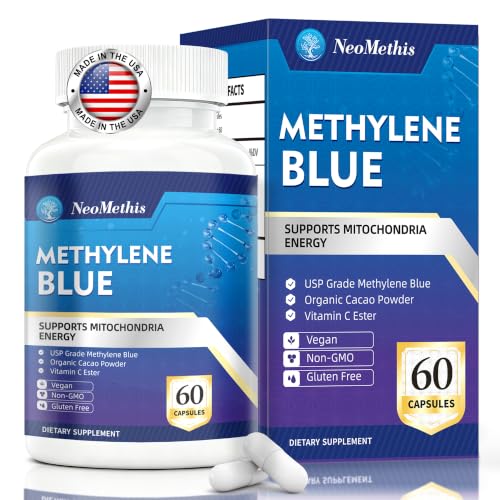
On the question of product quality: only USP-grade (pharmaceutical-purity) methylene blue is appropriate for human use. Industrial grades, laboratory reagent grades, and histology dyes contain heavy metal contaminants and other impurities that are toxic and invisible to the consumer. The deep blue color of a product provides no information about its purity.
Finally, the evidence reviewed in this article is predominantly from animal models and in-vitro systems. Human clinical trials on methylene blue specifically for mitochondrial enhancement or cognitive support are limited in number, scale, and duration. Mechanistic plausibility established in animal studies is a starting point for research, not a substitute for it. The gap between a promising preclinical finding and a validated human intervention is large, and current evidence does not close it.
🛒 Where to Buy Methylene Blue
- Troscriptions Blue CannatineLab-tested / studied
sublingual troches, 4 mg methylene blue + 4 mg nicotine + 50 mg caffeine + 200 mg alpha-GPC per troche — Flagship stacked nootropic troche from Troscriptions (founded by physician Ted Achacoso MD); pharmaceutical-grade MB combined with cholinergic and stimulant cofactors; widely regarded as the benchmark MB product in the nootropic community. Confirm drug interaction checklist before use. - Double Wood Supplements Methylene Blue
capsules, 5 mg per capsule — Accessible entry-point brand widely available on Amazon; transparent third-party testing; one of the few capsule-form MB products from an established U.S. supplement company; good for low-dose protocols. - Health Natura Methylene Blue USP Solution
liquid, 0.5% solution, approximately 2.5 mg per 5 drops — Long-standing liquid MB brand; clear USP-grade labeling; 0.5% concentration referenced in historical clinical protocols; glass dropper bottle; available on Amazon. - BulkSupplements Methylene Blue Powder
powder, Variable — sold as raw tested powder; requires accurate milligram scale — Lowest cost-per-dose option for experienced users; lab-tested with published COA; not recommended for anyone new to the compound given the critical importance of accurate low-dose measurement.
As an Amazon Associate we earn from qualifying purchases. Methylene blue grade matters more than price or color: only USP, BP, or EP pharmaceutical grade is appropriate for human use, and aquarium, histology or industrial dye grades are not substitutes. Ask for a lot-specific third-party certificate of analysis with numerical results covering azure B and heavy metals, since a bare percent-purity figure says nothing about the remaining fraction.

A Note on the Evidence
The evidence reviewed here is predominantly from animal models and in-vitro studies; robust human clinical trials on methylene blue for mitochondrial support or cognitive enhancement are lacking, and preclinical findings do not reliably predict human outcomes. Methylene blue carries a serious FDA drug-interaction warning for potentially fatal serotonin syndrome when combined with SSRIs, SNRIs, tramadol, linezolid, or other serotonergic agents, and is absolutely contraindicated in G6PD deficiency — anyone considering its use should consult a qualified physician before doing so. This article is informational only and does not constitute medical advice.
Frequently Asked Questions
How exactly does methylene blue bypass Complex I?
In its oxidized form, MB accepts electrons from NADH — the same substrate that feeds Complex I — and once reduced to leucomethylene blue, donates those electrons directly to cytochrome c, bypassing both Complex I and Complex III. Animal research supports this mechanism: MB prevented neurodegeneration caused by rotenone, a specific Complex I inhibitor, in rat retinal cells [2], consistent with electron flow continuing through an alternative route.
Does methylene blue actually increase ATP levels in humans?
Directly measuring ATP increases in living humans from MB use is not something the current published evidence robustly establishes. What preclinical studies show is that MB can rescue function when normal ATP-generating pathways are blocked — for example, restoring spatial memory in rats whose cytochrome c oxidase was chemically inhibited [1]. Whether this translates to a meaningful ATP increase in healthy humans with intact mitochondria has not been established in controlled human trials.
What disease models has methylene blue been studied in?
Preclinical research has examined MB in models of Parkinson’s-like Complex I toxicity (rotenone in rat retina) [2], Huntington’s disease (Drosophila cardiac model) [6], cytochrome c oxidase inhibition (cognitive impairment in rats) [1], retinal ganglion cell senescence [5], and broader neurodegeneration contexts [7]. All of these are animal or cell-based studies; human clinical evidence in these conditions remains limited.
Is methylene blue safe to use as a daily nootropic supplement?
This cannot be answered with a simple yes or no. MB carries a serious FDA drug-interaction warning for potentially fatal serotonin syndrome with SSRIs, SNRIs, tramadol, and linezolid; it is absolutely contraindicated in G6PD deficiency; and doses above roughly 4 mg/kg can paradoxically cause methemoglobinemia. Long-term daily use in healthy humans has not been studied in controlled trials. Anyone considering use should consult a qualified physician, particularly to review their current medications.
What grade of methylene blue is appropriate for human use?
Only USP-grade (pharmaceutical-purity) methylene blue is appropriate for human use. Industrial, laboratory reagent, and histology-grade products contain heavy metal contaminants and other toxic impurities that cannot be detected by appearance. The vivid blue color of a product gives no indication of its purity or safety.
Is there a connection between methylene blue and light therapy for mitochondrial support?
Both low-level photobiomodulation and methylene blue are proposed to influence cytochrome c oxidase activity through different mechanisms, and researchers have noted mechanistic overlap in the neurological applications literature [4]. Whether combining them produces additive benefit in humans has not been evaluated in controlled trials. The convergence is scientifically interesting as a research direction, not an established clinical protocol.
References
- Callaway NL et al. Methylene blue restores spatial memory retention impaired by an inhibitor of cytochrome oxidase in rats. Neuroscience letters (2002). PMID 12384216
- Zhang X et al. Methylene blue prevents neurodegeneration caused by rotenone in the retina. Neurotoxicity research (2006). PMID 16464752
- Hubenova Y et al. Mitochondrial origin of extracelullar transferred electrons in yeast-based biofuel cells. Bioelectrochemistry (Amsterdam, Netherlands) (2015). PMID 24997719
- Rojas JC et al. Neurological and psychological applications of transcranial lasers and LEDs. Biochemical pharmacology (2013). PMID 23806754
- Daudt DR 3rd et al. Methylene blue protects primary rat retinal ganglion cells from cellular senescence. Investigative ophthalmology & visual science (2012). PMID 22661471
- Heidari R et al. Methylene Blue Partially Rescues Heart Defects in a Drosophila Model of Huntington's Disease. Journal of Huntington's disease (2015). PMID 26397898
- Poteet E et al. Neuroprotective actions of methylene blue and its derivatives. PloS one (2012). PMID 23118969
These statements have not been evaluated by the Food and Drug Administration. This information is not intended to diagnose, treat, cure, or prevent any disease. Content is for informational purposes only and is not medical advice; consult a qualified healthcare provider before starting any supplement. As an Amazon Associate we earn from qualifying purchases.