Methylene blue (methylthioninium chloride) is a small, lipophilic cationic molecule with a molecular weight of roughly 320 daltons. That chemical profile matters practically: it absorbs across biological membranes relatively readily, distributes widely throughout body tissues, and crosses the blood-brain barrier — properties that make it genuinely interesting for the proposed nootropic and mitochondrial-support applications researchers are currently investigating. What is less often discussed is that those same properties interact with the delivery form you choose, affecting how quickly the compound enters your bloodstream, how much reaches target tissues, and how manageable the experience is day to day.
Three forms dominate the consumer and compounding pharmacy market: aqueous liquid solutions, oral capsules, and sublingual troches. Each involves a different absorption pathway and carries distinct tradeoffs in onset speed, dosing precision, palatability, and staining. This article walks through those tradeoffs honestly. Because controlled pharmacokinetic comparisons of these specific methylene blue formats in humans are limited in the published literature, some of what follows draws on established pharmacological principles for compounds with similar properties rather than direct head-to-head clinical trials. No citations are invented here; where direct human trial data on MB delivery forms is simply not yet published, that is stated plainly.
Key Takeaways
- Liquid solutions offer the finest dosing granularity and fastest oral absorption onset, but require careful handling to avoid staining and demand USP pharmaceutical-grade purity.
- Capsules provide the most convenient and travel-friendly format but introduce a dissolution lag that delays absorption relative to liquid; compounding pharmacy quality controls vary.
- Sublingual troches theoretically offer the fastest onset and highest peak bioavailability by bypassing first-pass hepatic metabolism, but require a compounding pharmacy and cost more per dose.
- Methylene blue is dose-sensitive: the low-dose window (roughly 0.5–4 mg/kg) has a different proposed mechanism than higher doses, making accurate measurement important across all formats.
- Delivery form does not alter the serious drug interaction risk with serotonergic medications or the absolute contraindication in G6PD deficiency — these safety considerations apply regardless of how the compound is administered.
What 'Bioavailability' Actually Means for Methylene Blue
Bioavailability refers to the fraction of an administered dose that reaches systemic circulation in an active form, and the speed at which it does so. For a compound like methylene blue, two variables are especially relevant: first-pass hepatic metabolism and mucosal absorption kinetics. Oral routes — swallowing a capsule or a liquid solution — send the compound through the gastrointestinal tract and then through the portal vein to the liver before it reaches general circulation. The liver can metabolize methylene blue to leucomethylene blue and other metabolites, though MB is considered to have reasonably good oral bioavailability compared to many drugs because of its physicochemical properties.
Sublingual and buccal routes bypass the portal circulation. Compounds absorbed through the sublingual mucosa enter the internal jugular vein directly, reaching systemic circulation without a hepatic first pass. For drugs that undergo significant first-pass metabolism, this difference can meaningfully increase the fraction of the dose that reaches the bloodstream. Whether that hepatic bypass produces a clinically significant bioavailability advantage specifically for methylene blue — as opposed to simply altering the time-concentration curve — has not been established by published pharmacokinetic studies in humans as of this writing. That is an honest gap in the available evidence.
Liquid Solutions: The Oldest and Most Flexible Form
Aqueous methylene blue solutions, typically sold at concentrations of 1% (10 mg per mL), are the oldest delivery form and remain the standard in clinical and research settings. Liquid offers genuine advantages in dosing flexibility: precise microdosing in the range of 0.5–4 mg that many researchers consider the ‘hormetic’ low-dose window is practically easier to achieve with a calibrated dropper than with pre-formed capsules. Dilution in water or juice is straightforward and reduces the intensity of the direct oral contact with the dye.
The practical downsides are real. Methylene blue is an intensely colored dye — it will stain teeth, gums, tongue, clothing, and countertops on contact. Users report that the blue discoloration of urine and sometimes stool, while harmless at low doses, can be alarming if not anticipated. Liquid solutions also require refrigeration after opening in most cases to maintain stability, and travel is more cumbersome than capsules. Taste is distinctive and unpleasant to most people without significant dilution.
Purity is a critical concern with liquid forms specifically. Only USP-grade (pharmaceutical-grade) methylene blue is appropriate for human consumption. Industrial-grade, laboratory-staining-grade, and aquarium-treatment-grade products contain toxic impurities including heavy metals and manufacturing byproducts that are not acceptable at any dose. This is not a minor distinction — it is a safety issue, and it applies to all delivery forms but is especially worth emphasizing for liquids because they are widely available from non-pharmaceutical sources at low prices.

Oral Capsules: Convenience at a Pharmacokinetic Cost
Encapsulated methylene blue powder or pellets appeal to users who want a clean, travel-friendly format without direct oral contact with the dye. Capsules effectively eliminate the staining of teeth and oral mucosa during administration, and pre-measured doses remove the need for dropper calibration. These are legitimate quality-of-life advantages that improve adherence for people using methylene blue on a consistent schedule.
From a pharmacokinetic standpoint, oral capsules introduce absorption delays that liquid forms do not. The capsule shell — whether gelatin or vegetarian cellulose — must dissolve in gastric fluid before the compound is even available for absorption. This adds a lag phase of typically 15–30 minutes before significant release, followed by absorption primarily in the upper small intestine. Peak plasma concentrations from oral capsule administration are expected to arrive later and may be somewhat lower than from an equivalent liquid dose consumed in diluted solution, though published controlled comparisons for methylene blue specifically are not available in the open literature.
Compounding pharmacies that prepare methylene blue capsules may use different fillers, binders, and release profiles. A standard-release formulation behaves differently from an enteric-coated one. Consumers purchasing compounded capsules should ask their pharmacist about the release mechanism and filler ingredients, particularly if they have known sensitivities.

Sublingual Troches: The Case for Bypassing First-Pass Metabolism
Troches are small, slow-dissolving lozenges designed to be held under the tongue or against the cheek until fully dissolved, usually over 5–15 minutes. They are a compounding pharmacy staple, used for hormones, pain medications, and other compounds where avoiding first-pass metabolism or achieving rapid onset is clinically valuable. The sublingual mucosa is thin, highly vascularized, and permeable to lipophilic compounds — characteristics that methylene blue, as a small lipophilic molecule, is positioned to benefit from.
The theoretical advantage of sublingual troches for methylene blue is faster entry into systemic circulation and potentially higher peak concentrations compared to the same dose swallowed in capsule form, because the hepatic first-pass step is largely bypassed. Users who have compared formats anecdotally often report faster subjective onset with sublingual administration — a sense of mental clarity or mild stimulation arriving within 20–30 minutes rather than 45–90 minutes. Anecdote is not clinical data, and these reports cannot substitute for controlled pharmacokinetic measurement, but they are directionally consistent with what basic pharmacology would predict.
Troches do not eliminate oral staining entirely — methylene blue will color the tongue and mouth during dissolution. They also require a compounding pharmacy prescription in most jurisdictions, making them less accessible than over-the-counter liquid drops. Cost per dose from a compounding pharmacy is typically higher than equivalent liquid or capsule options. For individuals who find the delayed onset of capsules frustrating or who are trying to time methylene blue administration around cognitive tasks, troches represent the most pharmacologically rational choice among the three formats.
Dosing Accuracy Across Forms
Methylene blue is dose-sensitive in ways that make accuracy more important than for many supplements. At low doses — commonly cited in the research literature as roughly 0.5 to 4 mg/kg body weight, though most nootropic users work in absolute doses of 5–20 mg — the compound behaves as a mild antioxidant and proposed mitochondrial electron carrier.[3] At doses above approximately 4 mg/kg, it can paradoxically cause the methemoglobinemia it is FDA-approved to treat at low doses by overwhelming the reducing capacity of red blood cell enzymes.[2] This dose-response inversion makes precise dosing a genuine safety consideration, not a formulation technicality.
Liquid forms with a calibrated dropper offer the finest dosing granularity, allowing adjustments of 1 mg or less. Pre-filled capsules from a compounding pharmacy or supplement manufacturer are fixed at a stated dose with tolerances that vary by manufacturer. Home users who attempt to open capsules and re-dose by weight introduce significant error unless using a precision milligram scale. Troches are also fixed-dose as prepared by a compounding pharmacy, with the same caveat that lot-to-lot consistency depends on the pharmacy’s quality controls. For very low-dose exploration in the 1–5 mg range, liquid with a dropper calibrated in milligrams remains the most controllable format.
Safety Considerations That Apply to All Forms
The delivery form does not change methylene blue’s serious drug interaction profile. Methylene blue is a potent monoamine oxidase inhibitor, and the FDA has issued warnings regarding serotonin syndrome risk when it is co-administered with serotonergic drugs — including SSRIs, SNRIs, tramadol, linezolid, and other MAOIs.[1] This interaction has been documented in surgical and clinical settings where intravenous methylene blue was used as a dye, and the risk extends to oral administration. Anyone currently taking any serotonergic medication must not use methylene blue without direct supervision from a physician who is aware of the combination.
G6PD (glucose-6-phosphate dehydrogenase) deficiency is an absolute contraindication for methylene blue in any form or dose. G6PD deficiency impairs the reduction of methylene blue back from its oxidized form, and administration can trigger severe, potentially life-threatening hemolytic anemia. G6PD deficiency is common in populations of African, Mediterranean, Middle Eastern, and Southeast Asian ancestry and is frequently undiagnosed. Testing before use is appropriate if there is any personal or family history or ethnic background that raises the possibility.
Pregnancy and breastfeeding are additional contraindications. Methylene blue has been associated with adverse fetal outcomes in obstetric use and is not appropriate for use during pregnancy. Only pharmaceutical-grade material is appropriate for any human use regardless of delivery form, and individuals with any significant health condition or medication regimen should consult a physician before using methylene blue in any format.
🛒 Where to Buy Methylene Blue
- Troscriptions Blue CannatineLab-tested / studied
sublingual troches, 4 mg methylene blue + 4 mg nicotine + 50 mg caffeine + 200 mg alpha-GPC per troche — Flagship stacked nootropic troche from Troscriptions (founded by physician Ted Achacoso MD); pharmaceutical-grade MB combined with cholinergic and stimulant cofactors; widely regarded as the benchmark MB product in the nootropic community. Confirm drug interaction checklist before use. - Double Wood Supplements Methylene Blue
capsules, 5 mg per capsule — Accessible entry-point brand widely available on Amazon; transparent third-party testing; one of the few capsule-form MB products from an established U.S. supplement company; good for low-dose protocols. - Health Natura Methylene Blue USP Solution
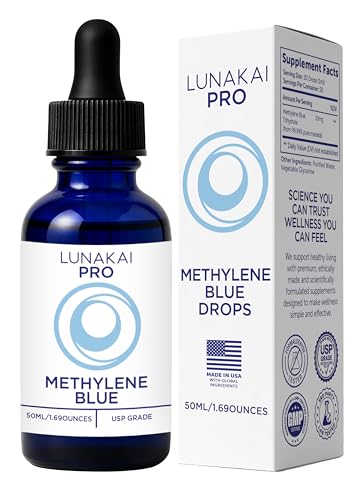
liquid, 0.5% solution, approximately 2.5 mg per 5 drops — Long-standing liquid MB brand; clear USP-grade labeling; 0.5% concentration referenced in historical clinical protocols; glass dropper bottle; available on Amazon. - BulkSupplements Methylene Blue Powder
powder, Variable — sold as raw tested powder; requires accurate milligram scale — Lowest cost-per-dose option for experienced users; lab-tested with published COA; not recommended for anyone new to the compound given the critical importance of accurate low-dose measurement.
As an Amazon Associate we earn from qualifying purchases. Methylene blue grade matters more than price or color: only USP, BP, or EP pharmaceutical grade is appropriate for human use, and aquarium, histology or industrial dye grades are not substitutes. Ask for a lot-specific third-party certificate of analysis with numerical results covering azure B and heavy metals, since a bare percent-purity figure says nothing about the remaining fraction.

A Note on the Evidence
No direct head-to-head clinical pharmacokinetic trials comparing methylene blue liquid, capsule, and sublingual troche forms in humans have been published in the peer-reviewed literature available at the time of writing; bioavailability comparisons here are grounded in established pharmacological principles for molecules with similar properties, not measured human data. Methylene blue is a potent MAO inhibitor with an FDA serotonin syndrome warning when combined with serotonergic medications and is absolutely contraindicated in G6PD deficiency; consult a physician before use if you take any medications, are pregnant, or have any known medical condition.
Frequently Asked Questions
Does sublingual methylene blue absorb faster than swallowed liquid?
Based on established pharmacological principles for lipophilic cationic molecules, sublingual administration should produce faster systemic absorption and bypass hepatic first-pass metabolism compared to swallowed liquid. However, controlled pharmacokinetic studies directly comparing these routes for methylene blue in humans have not been published in the available peer-reviewed literature, so quantitative bioavailability differences cannot be stated with precision at this time.
Why does the delivery form matter if methylene blue is generally well-absorbed orally?
Even compounds with good overall oral bioavailability can show meaningful differences in time-to-peak plasma concentration across delivery forms. For users timing methylene blue around specific cognitive tasks or activities, an onset difference of 30–60 minutes between capsule and sublingual routes may be practically significant. Dosing accuracy also varies substantially between forms, which matters for a compound where the therapeutic and adverse-effect dose ranges are closer together than for many supplements.
Can I just open a methylene blue capsule and dissolve it under my tongue?
This is not recommended. Capsule fillers and binders are formulated for GI dissolution and may not be appropriate for direct sublingual contact. Compounded sublingual troches use excipients selected specifically for mucosal compatibility. Additionally, powder handling without a precision scale introduces dosing error, and direct powder contact with mucosa can cause local irritation.
Is the blue staining from liquid forms a sign something is wrong?
No. Methylene blue is an intensely colored dye, and blue or blue-green discoloration of saliva, urine, and sometimes stool is expected at any dose. Urine discoloration is a predictable pharmacological consequence of renal excretion and not an indicator of harm. The staining of teeth and oral tissues from liquid is temporary and cosmetic, though it can be reduced by diluting the liquid in a larger volume of water before drinking.
What concentration liquid solution is standard for human use?
One percent solutions (10 mg per mL) are the most common concentration available from compounding pharmacies and pharmaceutical-grade suppliers. This concentration allows reasonably precise low-dose measurement with a calibrated dropper. Some compounding pharmacies offer 0.5% solutions (5 mg/mL) for users working in very low dose ranges. Industrial or histology-grade methylene blue solutions at any concentration are not appropriate for human use due to toxic impurities regardless of the concentration listed.
Do troches require a prescription?
In the United States, methylene blue troches are typically prepared by compounding pharmacies and generally require a prescription from a licensed practitioner. Regulations vary by jurisdiction. Over-the-counter liquid methylene blue products marketed as supplements exist in a gray regulatory area, and quality controls vary widely — USP-grade verification is essential for any product considered for human use.
References
- Methylene blue: a controversial diagnostic acid and medication? Toxicology Research (2022). PMID 36337249
- The Potentials of Methylene Blue as an Anti-Aging Drug. Cells (2021). PMID 34943887
- From Mitochondrial Function to Neuroprotection – an Emerging Role for Methylene Blue. Molecular Neurobiology (2018). PMID 28840449
These statements have not been evaluated by the Food and Drug Administration. This information is not intended to diagnose, treat, cure, or prevent any disease. Content is for informational purposes only and is not medical advice; consult a qualified healthcare provider before starting any supplement. As an Amazon Associate we earn from qualifying purchases.